-Estimates maximum current carrying capacity of PCB copper traces based on trace geometry, copper weight, and allowable temperature rise.
- Two calculation methods provided — IPC-2221 (widely adopted industry standard) and IPC-2152 (empirically derived, more accurate for modern PCB materials).
- Use the IPC-2221 sheet or IPC-2152 sheet depending on your project's quality system requirements.
- Summary Report sheet consolidates both results for easy comparison.
- Essential for sizing high current traces in SiC inverters, BMS busbars, and DC-DC converter PCBs before layout begins.
- Released under free license — download and use in personal and commercial projects at no cost.
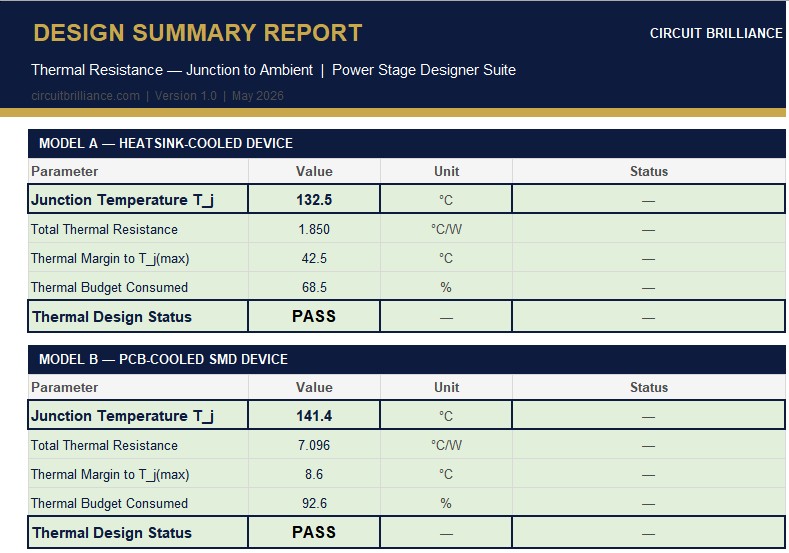
- Estimates the junction temperature of a power semiconductor device by modelling the complete thermal resistance chain from junction to ambient.
- Two thermal models provided — Heatsink-Cooled model for through-hole and press-fit devices mounted on a heatsink, and PCB-Cooled model for SMD devices dissipating heat through copper pours and thermal vias.
- Heatsink-Cooled model covers steady-state thermal analysis for TO-247, TO-220, D2PAK, and similar packages with thermal interface material.
- PCB-Cooled model covers steady-state thermal analysis for DFN, QFN, D2PAK-SMD, and similar packages dissipating heat into PCB copper plane through thermal pad and via array.
- Summary Report sheet consolidates both models for design review and fabrication release documentation.
- Both models assume steady-state conditions — not valid for pulse power or transient thermal analysis.
- Released under free license — download and use in personal and commercial projects at no cost.
These calculators and guidelines give you the numbers. Circuit Brilliance turns those numbers into verified, production-ready PCB designs. Talk to us about your next power electronics project.